CoFAI Reference Software Implementation
This guide explains how the reference software implements the CoFAI framework, including component responsibilities, public interfaces, and implementation status. Method-specific guides provide reproduction instructions.
See the evaluation engine guide for the contracts governing plans, datasets, transforms, task meters, and result files.
1. Implementation Layers
An evaluation plan selects the experimental conditions and components. The engine builds and runs them; model classes connect backbones, codecs, and task heads; reusable components implement their individual operations.
flowchart TB
  P[plan YAML<br/>conditions and component configuration]
  E[cofai.engine<br/>building, evaluation, bitrate, results]
  M[cofai.models<br/>backbone-codec-head orchestration]
  C[reusable components<br/>backbone / latent codec / index codec / head]
  X[examples<br/>method adaptation, training, dedicated evaluation]
  P --> E --> M --> C
  X --> M
X --> Ccofai/contains reusable components and shared evaluation support.conf/plan/contains runnable evaluation plans.examples/contains method-specific adaptation, training, offline experiments, and implementations that have not yet been integrated into shared components.
2. Component Namespaces
| Namespace | Responsibility | Examples |
|---|---|---|
cofai.backbone |
Model prefixes, suffixes, and split-point features | DINOv2, DINOv3, Qwen3-VL, GPS/TransReID |
cofai.latent_codecs |
Coding feature values or token values | MPC, VTC, VQFC, ORFC, VTM, raw dtype, bypass |
cofai.index_codecs |
Coding discrete indices and selection maps | Uniform index, adaptive bitmap index |
cofai.token_grouping |
Token selection, grouping, and structural results | GPS token grouping |
cofai.heads |
Task prediction or reconstruction | Classification, segmentation, depth, RAE, ReID |
cofai.datasets |
Images, features, video, and task data | Classification, segmentation, NYUv2, MMStar |
cofai.metrics |
Task metrics and per-sample aggregation | Accuracy, mIoU, depth, VQA, image quality |
cofai.engine |
Plan execution and shared evaluation contracts | Registry, EvalBatch, bitrate, profiling |
Feature-value coding belongs to latent_codecs; discrete-index coding belongs to index_codecs. These namespaces replace the earlier token_codecs namespace and distinguish the semantics of the coded data.
3. Model Orchestration
cofai.models combines components into complete coding and task-inference pipelines.
| Model | Purpose | Implementation status |
|---|---|---|
DinoFeatureCodecModel |
Single-window DINOv2/DINOv3 feature coding and multi-task decoding | Main shared evaluation path |
DinoSlideFeatureCodecModel |
Sliding-window feature coding and segmentation fusion | Specialized shared path |
Qwen3vlFeatureCodecModel |
Qwen3-VL vision-feature coding and VQA generation | CTC evaluation path |
CommonFeatureCodecModel |
General feature coding with optional token grouping and index side streams | Experimental interface |
| MPC models | Joint coding of multi-layer features and image context | Method-specific compatibility paths |
| MLoRE frame/video models | RFC multi-task models and video containers | Method-specific paths |
Shared evaluation paths have common plans and component boundaries. Experimental interfaces may change as methods evolve. Method-specific paths have not yet fully converged on the shared model interfaces.
4. DINO Feature Coding
DinoFeatureCodecModel connects a backbone, a latent codec, and task heads.
flowchart LR
  I[image] --> BP[backbone prefix] --> H[split tokens h]
  H --> LC[latent codec] --> HH[reconstructed tokens h_hat]
  HH --> BS[backbone suffix] --> HD[task heads] --> MT[task metrics]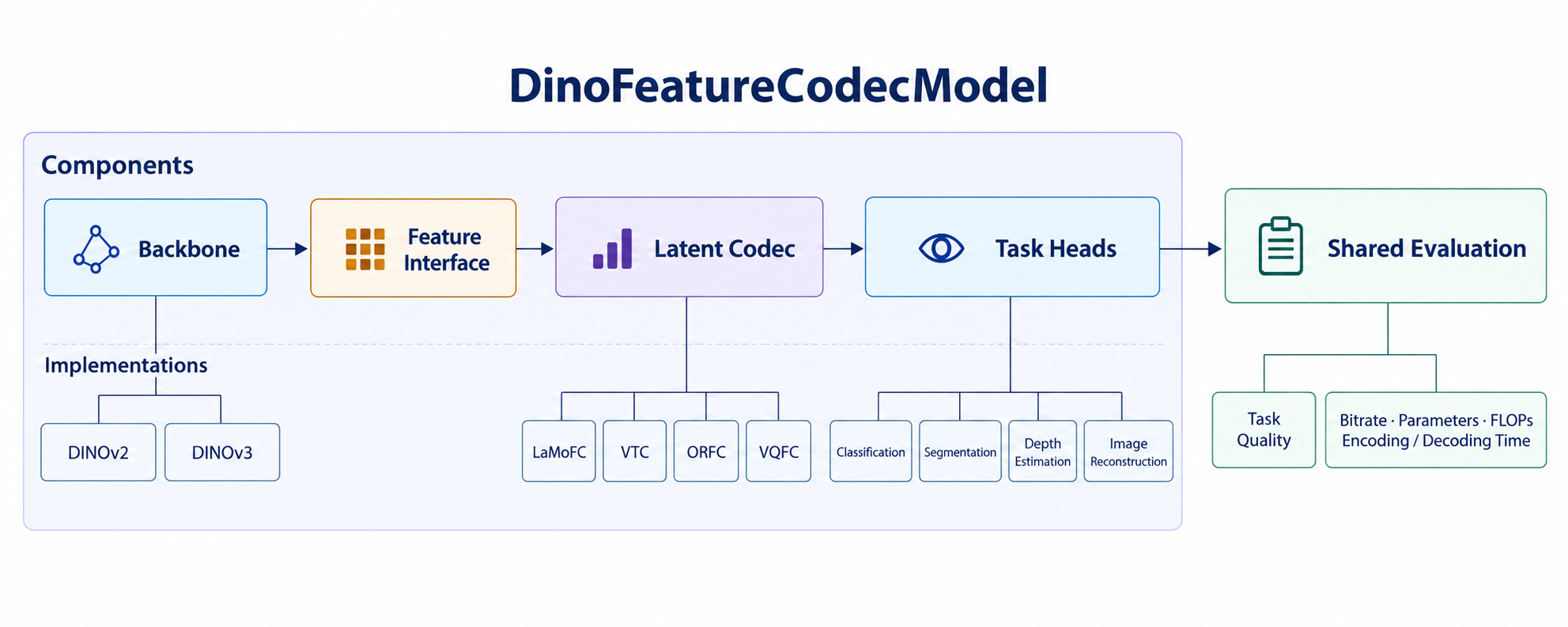
Evaluation supports two bitrate paths:
forward_testcalls the codec's forward interface and readslikelihoodsorbits.compress/decompressproduce and consume actualstringsfor coded-size and encoding/decoding-time measurements.
The model stores token_res in pstate so the decoder can recover the spatial meaning of the token sequence. Depending on the configured heads, reconstructed features support classification, segmentation, depth estimation, and image reconstruction.
DinoSlideFeatureCodecModel adds sliding-window crops, per-crop coding, and full-image logit fusion. It uses a type: slide_crops coded-data container; bitrate accounting sums the streams from all crops.
5. Qwen3-VL Feature Coding
Qwen3vlFeatureCodecModel also splits a backbone around a codec, but VQA does not use a separate generic task head. Decoded visual tokens re-enter the vision-encoder suffix, and the language model generates the answer.
image + prompt
  -> Qwen3-VL vision prefix
  -> vision tokens
  -> latent codec
  -> vision suffix
  -> language model generation
  -> VQA metric
The prompt is a task input used during decoding and generation; it is not passed to the feature codec's compress method. The current shared CTC plan uses MMStar and slot 9.
6. Slots and Model Split Points
Transformer blocks are numbered from Layer 0. CoFAI names their tensor boundaries as follows:
- The input to
Layer nisSlot n. - The output of
Layer nisSlot n+1.
The output of DINOv3 Layer 23 is therefore Slot 24. This separates the number of executed blocks from the tensor boundary and avoids confusing Transformer layers with CoFAI representation layers.
flowchart LR
  S0((Slot n)) --> L[Layer n] --> S1((Slot n+1))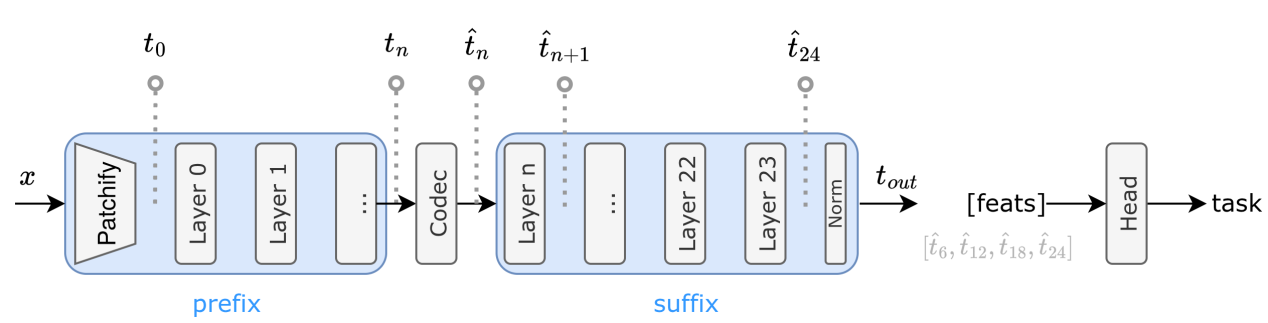
Current shared CTC plans include:
| Model | Slot | Tasks |
|---|---|---|
| DINOv3 ViT-L/16 | 24 | ADE20K segmentation, NYUv2 depth |
| Qwen3-VL 8B Instruct | 9 | MMStar VQA |
Use slot names in plan names, configuration fields, and reports. When citing layer numbers from earlier documents, also give the corresponding slot to avoid an off-by-one ambiguity.
7. Token Grouping and Multi-Stream Data Units
Token grouping produces compact features and discrete indices describing selection or grouping relationships.
The conceptual feature-branch diagram includes token preprocessing, separate feature and mask/index coding, and token restoration before the task module. In the current implementation, token preprocessing belongs to the relevant backbone's encode method. post_process is a reserved, unimplemented extension point and must currently be None.
The experimental CommonFeatureCodecModel currently follows these rules:
- A simple backbone's
encodemay return a tensor alone. - A backbone requiring structural side information returns
h,pstate, and rawindex_sets. - The backbone does not write byte streams.
- The latent codec codes
h; configured index codecs code the correspondingindex_sets. - The model places all streams in the same CodedUnit's flat
stringsmapping.
flowchart TB
  subgraph ENC["Encode"]
    X["input"] --> BE["backbone.encode"]
    BE --> H["h: compact features"]
    BE --> PS["pstate: backbone state"]
    BE --> IS["index_sets: raw indices"]
    H --> LC["latent codec.compress"]
    IS --> IC["index codecs.encode_batch"]
  end
  LC --> CU["CodedUnit: flat strings + merged pstate"]
  IC --> CU
  PS --> CU
  subgraph DEC["Decode"]
    CU --> SPLIT["split codec streams/state from backbone state"]
    SPLIT --> LD["latent codec.decompress"]
    SPLIT --> IV["index codecs.decode_batch"]
    LD --> HH["h_hat: compact features"]
    SPLIT -->|"backbone pstate"| BD["backbone.decode"]
    IV --> VALID["validation only; indices not consumed"]
    HH -->|"current path"| BD
    BD --> HEADS["optional task heads"] --> OUT["task outputs"]
  end
  PP["Token post_process: reserved; currently None"]
  HH -. "reserved feature input" .-> PP
  IV -. "reserved index input" .-> PP
  PP -. "future restored tokens" .-> BD
Decoded index side streams currently undergo decodability validation only. Their indices do not yet restore h_hat or a dense token grid.
encoded = {
    "h": compact_features,
    "pstate": {"token_res": (height, width)},
    "index_sets": {"selection_map": bounded_indices},
}

coded_unit = {
    "strings": {
        "feature": [[feature_bytes]],
        "selection_map": [[map_bytes]],
    },
    "pstate": {...},
}
selection_map and feature are distinct named streams within one DU. Shared bitrate accounting reports each stream and their total.
The GPS ReID decoder consumes compact token sequences directly rather than restoring a complete two-dimensional grid. Dense token restoration remains part of the architecture through the reserved, unimplemented post_process interface.
8. CodedUnit and Bitrate Accounting
cofai.engine.bitrate accepts three bitrate sources for a single DU:
| Field | Meaning | Use |
|---|---|---|
strings |
Actual byte streams | Real coding and per-stream accounting |
likelihoods |
Probability-model outputs | Estimated bitrate |
bits |
Explicit component-provided bit counts | Analytical paths without likelihoods |
Actual stream size is computed from the total byte lengths. bits_from_coded_data supports unit, frame, frame_wise_video, layer_wise_video, and slide_crops containers.
These containers implement the encoder semantic conventions and support shared evaluation and bitrate aggregation. Complete serialization of pstate into interoperable high-level bitstream syntax remains under development.
9. Evaluation Engine and Plans
A plan specifies the dataset, transforms, model, weights, tasks, metrics, quality settings, and output location. The engine executes the following sequence:
Hydra compose
  -> component registry build
  -> dataset / transforms / EvalBatch
  -> model forward_test or compress/decompress
  -> task meters + bitrate + timing
  -> result.json + config.yaml
args.profile=true additionally measures latent-codec parameter count, encoding/decoding FLOPs, and runtime. args.multi_run=true evaluates the plan's quality settings and writes summary.json.
Task contracts separate kind from label: kind identifies the dataset's ground-truth semantics, while label identifies a model output. This allows multiple output variants for the same task to be compared.
10. Framework Coverage
| Framework level | Current implementations | Status |
|---|---|---|
| Single-layer, single-frame | DINO CTC, LaMoFC, VQFC, VTC, ORFC, GPS | Main evaluation paths |
| Multi-layer, single-frame | MPC branches and joint visual/feature coding | Implemented; interfaces still being unified |
| Multi-layer, multi-frame | CAVC, MLoRE video paths | Experimental and method-specific |
New methods should identify their framework level and preserve their actual cross-layer or temporal dependencies. Shared abstractions should reflect concrete reuse needs rather than prematurely fixing interfaces for a single method.
11. Integrating Reusable Components
Integration typically involves:
- Keeping the original runnable implementation and reproduction results in
examples/<method>/. - Establishing a baseline with the same weights, data, preprocessing, and metrics.
- Moving reusable backbones, codecs, heads, and metrics into
cofai/. - Expressing evaluation conditions in a plan.
- Comparing results before and after refactoring to verify equivalent evaluation behavior.
- Documenting resources, commands, result paths, and remaining limits in the method guide.
Keep this implementation guide synchronized with code and engine documentation as interfaces change.